Most homeowners learn what "actual cash value" means the hard way. A storm damages the roof, the contractor hands over a $22,000 quote, and the insurance company's check is for $8,000. Thats not an error, that is ACV coverage working exactly as designed.
Actual cash value (ACV) is what an insurer pays after subtracting an age-based value reduction from your replacement cost. The older the roof, the larger that reduction, and the smaller the check. For homeowners with older roofs in storm-prone states, the gap between the ACV payout and repair costs can reach five figures.
Knowing how ACV works before a storm hits can prevent a costly outcome.
What Is ACV in Home Insurance?
Actual cash value (ACV) in home insurance is the depreciated value of your property at the time of a covered loss. The National Association of Insurance Commissioners defines it as the cost to repair or replace your property based on its current value, including its age and wear and tear.
The formula is:
A roof installed 15 years ago has lost value in the eyes of an insurer. Even if replacing it today costs $24,000, the ACV payout reflects what the roof is worth now. The gap between those two numbers belongs to the homeowner.
How Age-Based Reductions Affect Your Payout
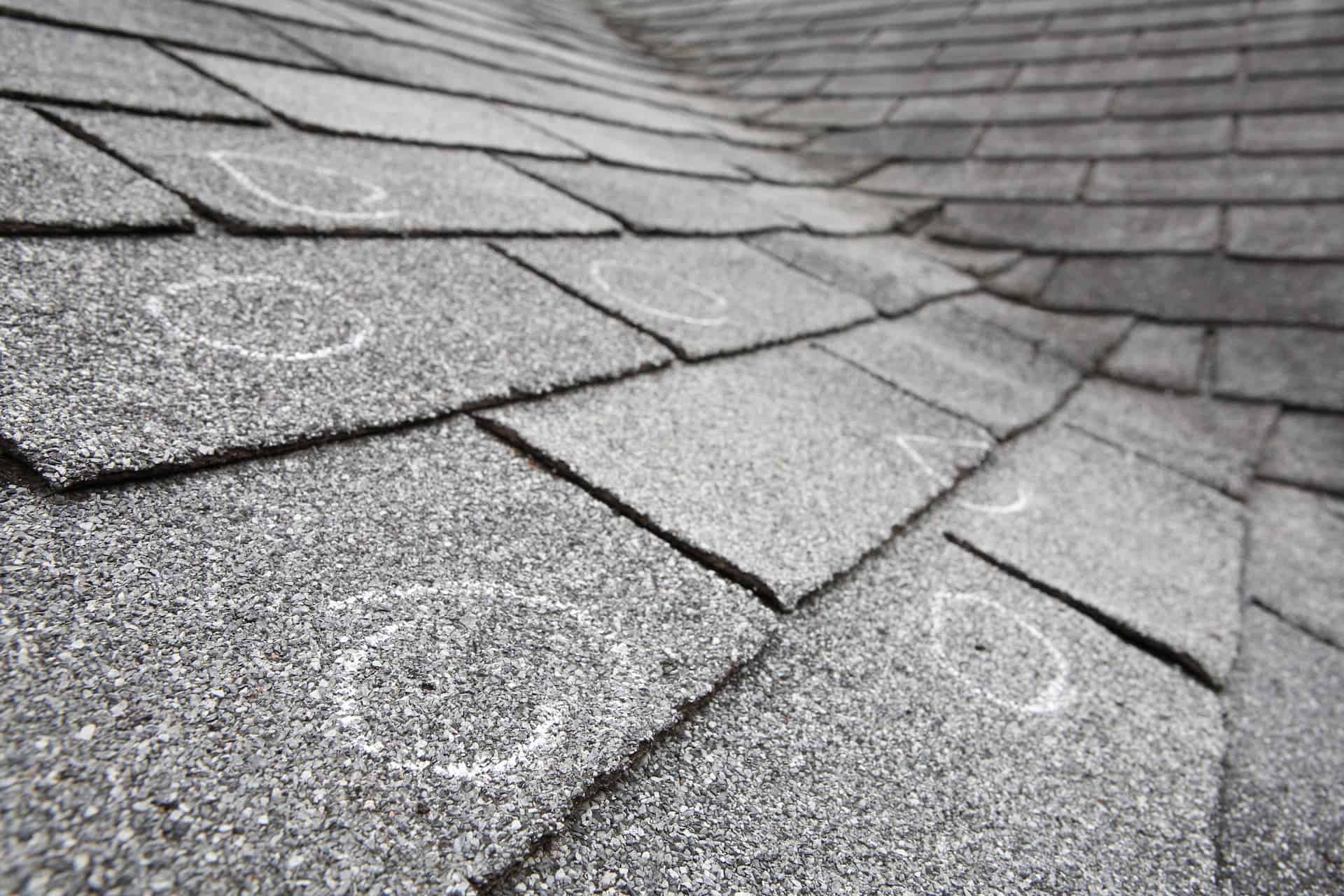
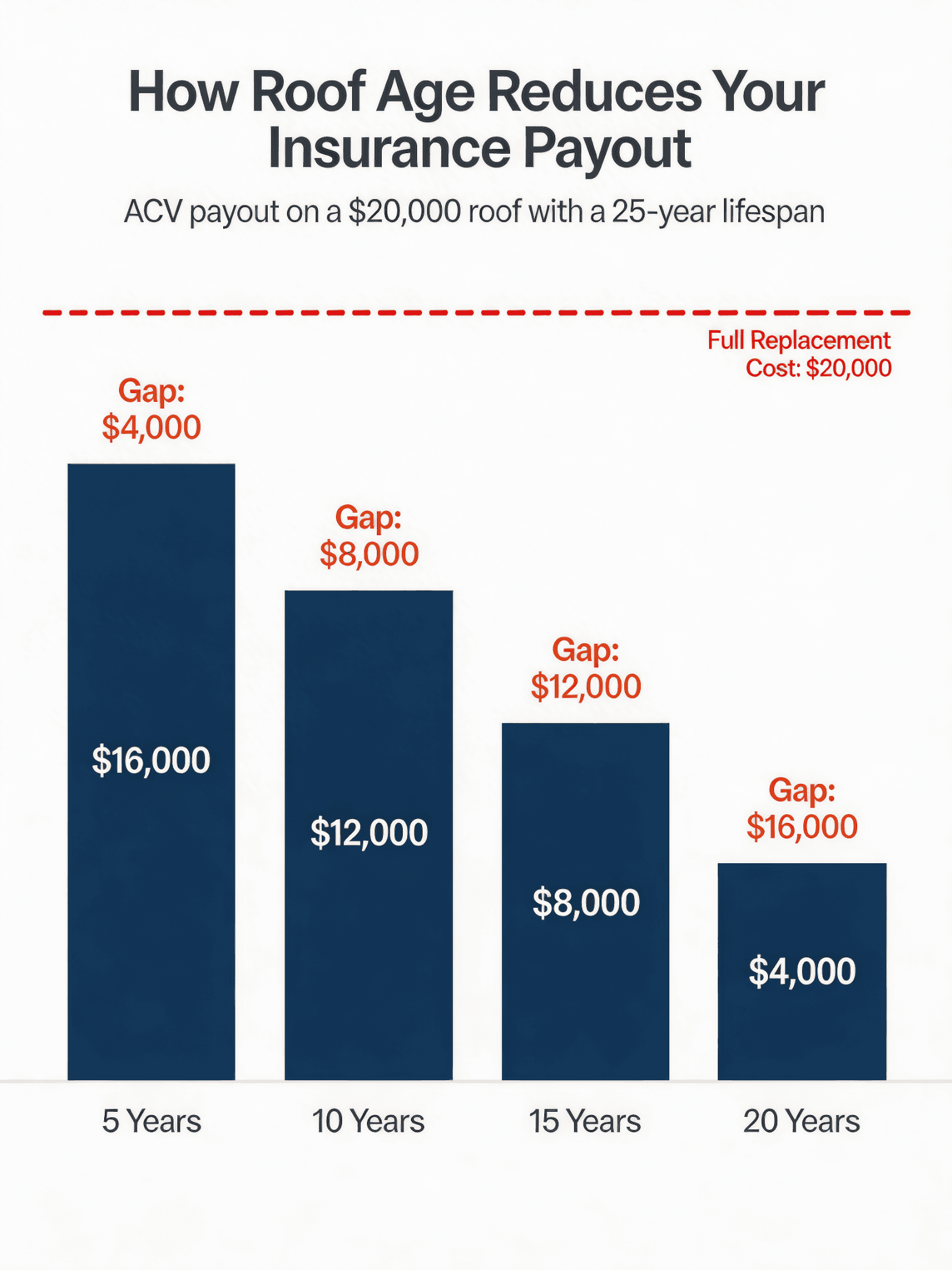
Insurers base the value reduction on a roof's expected lifespan and current age. Most carriers assign asphalt shingle roofs a 20 to 25 year lifespan. The older the roof, the larger the percentage removed from the claim.
On a $350,000 home with a 1% deductible, you owe $3,500 before your insurance company contributes anything.
A homeowner with a 15-year-old roof and $20,000 in storm damage could walk away with $4,500 on a repair that costs $20,000. That result follows directly from how ACV coverage calculates payouts.
ACV or RCV: Key Differences
Replacement cost value (RCV) pays to repair or replace your roof using similar roofing materials at today's prices, with no reduction for age.
ACV policies carry lower premiums. In high-risk areas, though, one storm can erase years of premium savings on a single claim.
Some RCV policies withhold a portion of the payout until you complete repairs and submit receipts. Homeowners may need to cover repair costs upfront and collect the remainder weeks later.
What ACV Means for Wind and Hail Damage
Wind and hail damage makes up about 34% of all homeowners insurance losses paid in the United States, according to the Insurance Information Institute.
Replacing a roof in 2025 costs between $9,000 and $30,000 or more depending on home size and roofing materials. An insurance company paying ACV on a 12-year-old shingle roof covers only a fraction of that.
Carriers in Texas, Kansas, Oklahoma, Iowa, and Nebraska have shifted to ACV-only roof coverage as storm losses rise. The Horton Group reported nearly $40 billion in storm losses in the first half of 2024 alone. Homeowners in these states carry ACV on their roofs most often and discover it after a claim most often.
What Is a Scheduled Roof Payout?
A scheduled roof payout assigns a fixed dollar cap to your claim based on your roof's age and material type. Standard ACV starts from current replacement cost and subtracts value loss. A scheduled payout skips that calculation entirely.
If the schedule caps a 12-year-old roof at $6,000, that is the maximum payout regardless of what a contractor quotes.
Scheduled payouts are most common in Texas, Kansas, Oklahoma, Iowa, and Nebraska. They typically produce lower payouts than even standard ACV.
To check whether your policy uses one: ask your agent to pull the roof endorsement language. Look for phrases like "roof payment schedule," "functional replacement cost," or "age-based roof schedule."
Why Many Homeowners Have ACV Without Knowing It
Three common reasons ACV ends up in a policy unannounced:
Most policies default to ACV for roofs at purchase. The roof endorsement is separate from the home's structure coverage. Agents do not always flag the distinction during the sale.
Carriers have tightened replacement cost availability. Insurance companies in high-storm states are restricting replacement cost coverage to newer roofs. A recent renewal in Texas, Kansas, Oklahoma, Nebraska, Iowa, Ohio, or Indiana may have shifted coverage without clear notice.
The roof aged past the coverage threshold. Many carriers only offer replacement cost coverage on roofs under 10 to 15 years old. After that, coverage moves to ACV at renewal.
/
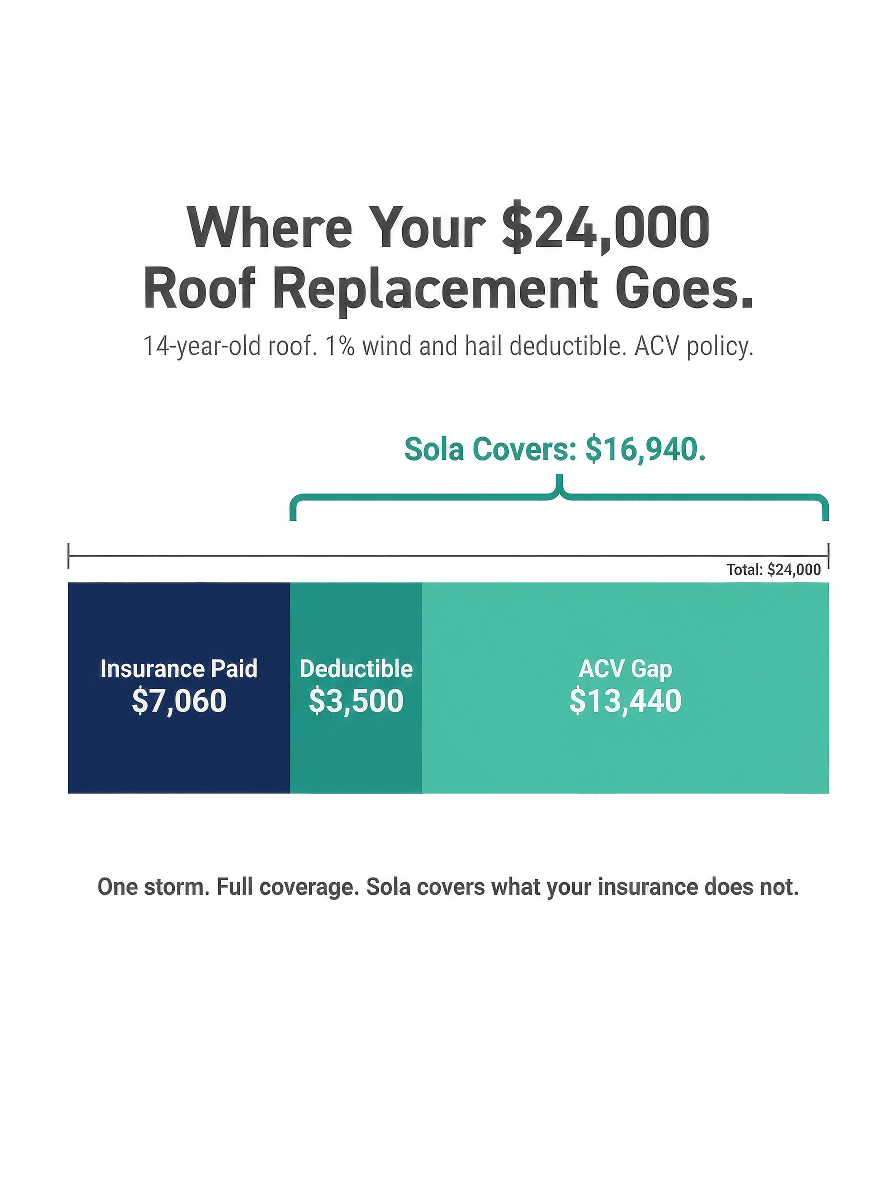
The Coverage Gap in Real Dollars
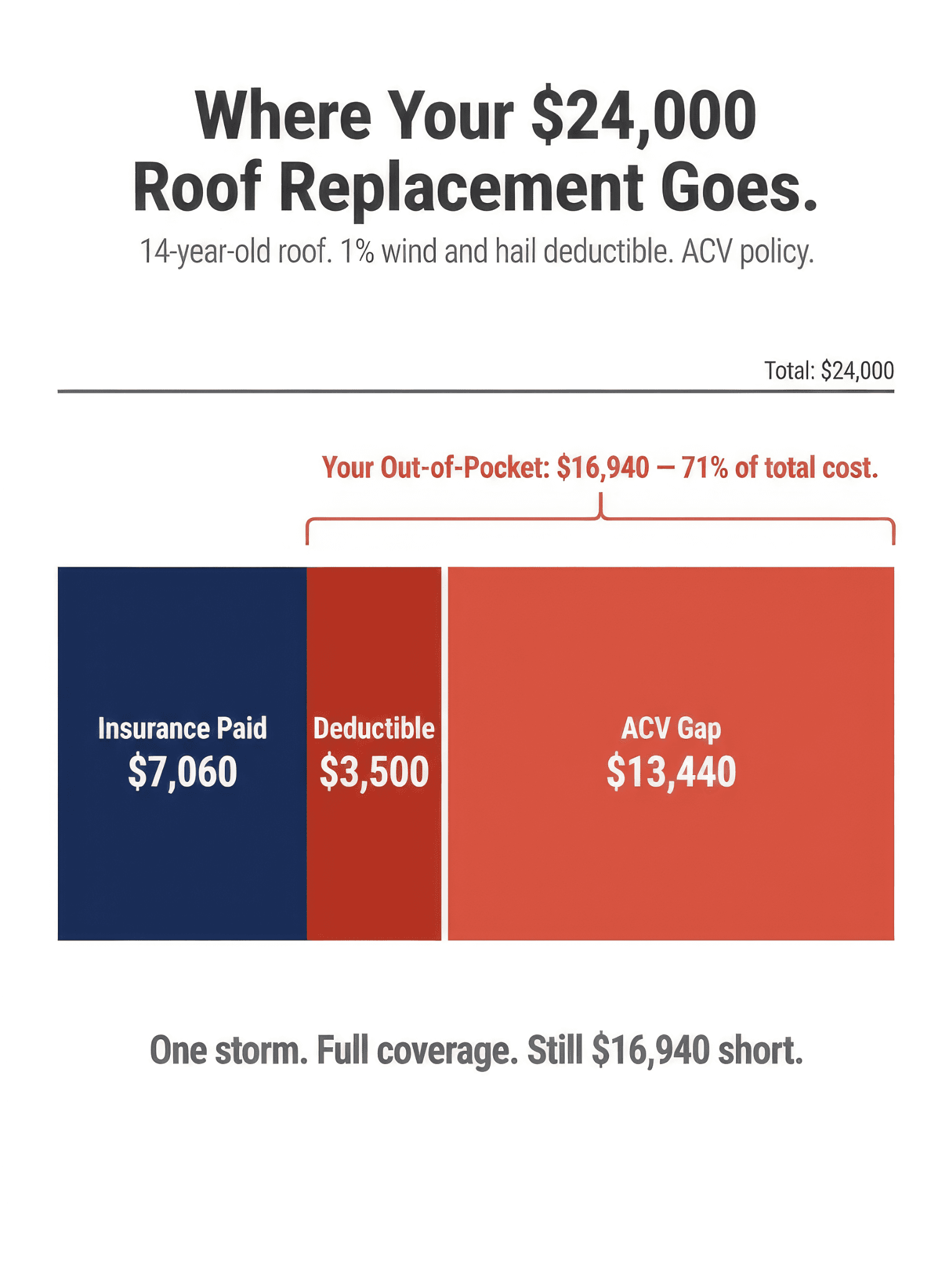
Nearly $17,000 out of pocket, with insurance, after a covered claim. For homeowners in storm-prone regions with older roofs, this outcome repeats constantly.
Sola is a supplemental wind and hail insurance policy that pays a fixed cash benefit based on verified National Weather Service data when a qualifying storm hits a property. That payout does not depend on the roof's age, an adjuster's estimate, or the homeowners policy's valuation method. It reaches the homeowner within days of a confirmed storm, not weeks.
How to Close the ACV Gap
Confirm how your policy values the roof. Your declarations page shows whether the roof uses ACV or RCV. Ask your agent to confirm in writing. Replacement cost coverage on the home's structure does not automatically extend to the roof.
Ask whether your policy uses a scheduled payout. Confirm the payout cap for your roof's current age. The gap between a scheduled payout and full replacement cost can reach tens of thousands of dollars.
Add supplemental wind and hail coverage. A policy like Sola Insurance pays based on weather data rather than claim adjustments. Apply the payout toward your deductible, the ACV shortfall, or contractor costs. Coverage does not affect homeowners premiums and does not appear in a CLUE report.
Recalculate your deductible. Raising a wind and hail deductible from 1% to 2% often lowers the homeowners premium. Those savings can cover the full yearly cost of a Sola policy. A product built to fill the gap replaces the gap that the higher deductible creates.
Frequently Asked Questions
What does ACV stand for in home insurance?
ACV stands for actual cash value. Insurers calculate it by taking the cost to replace damaged property. Then they subtract value lost due to age and wear and tear. Cash value ACV reflects what the item is worth today, not what it cost when new.
What is an ACV roof claim?
An ACV roof claim happens when a homeowner files a roof damage claim.
The insurance company pays the actual cash value, not the full replacement cost. The insurer starts from today's replacement cost and subtracts value loss based on the roof's age. For roofs more than 10 years old, this often reduces the payout by 50% to 80% compared to actual repair costs.
What is a scheduled roof payout?
A scheduled roof payout limits what an insurance company pays on a roof claim. The roof's age and material determine the cap. Rather than subtracting value loss from replacement cost, a scheduled payout assigns a fixed amount. Payouts are often lower than standard ACV and are most common in Texas, Kansas, Oklahoma, Iowa, and Nebraska.
How does ACV affect a wind and hail claim?
Roofs take the direct impact in most wind and hail events. An old roof and a percentage-based wind and hail deductible can leave homeowners paying most repair costs. This can happen even when the claim is covered.
How can homeowners cover the ACV gap?
A supplemental wind and hail policy pays a fixed cash benefit when a qualifying storm hits the property. The payout does not depend on the homeowners policy's valuation method or the roof's age. It can go toward the deductible, the ACV gap, or any storm-related cost.
Ask your agent how your policy covers wind and hail damage and whether a scheduled roof payout applies. To learn more, read the full guide at solainsurance.com/blog/acv-roof-claims.

COO